Summary: “Sandcastles - The Tsunami is Coming”
Why the future of animal welfare belongs to the AI-literate
Read the full post on Substack →
Quick intro from Joey:
“AI doesn’t really affect animal welfare—these are separate issues.” I had this (subconscious?) way of thinking until recently. Then I fell on this article by Aidan K which added some new perspective for me.
Substack suggested it might take me two hours to read, so after scanning some key points, I’ve made this nice Claude summary. I’ve tailored it to extract the bits that moved me most and left out things that didn’t.
Key takeaway: Animal welfare will massively change with AI. By becoming AI superusers, we can do more and be more competitive. See below for how.
The Economic Transformation Argument (What Moved Me)
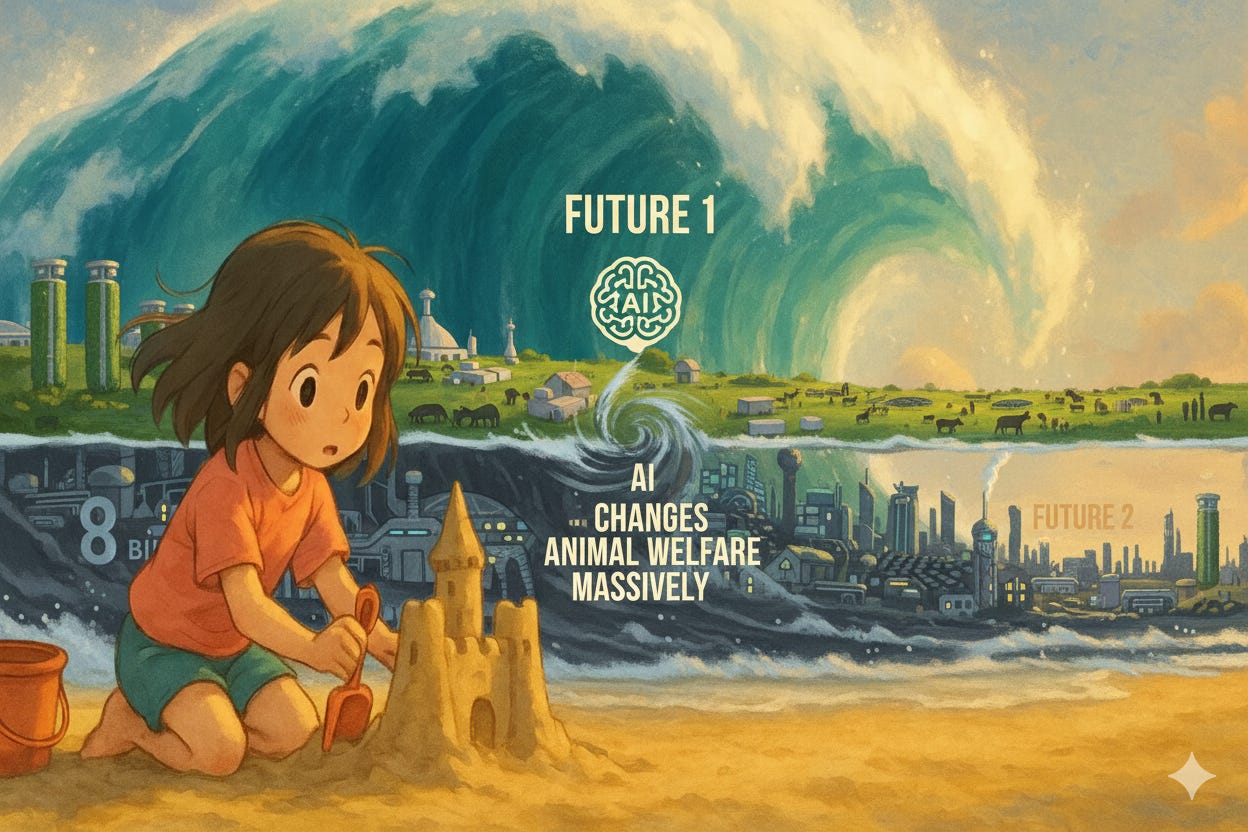
Two Possible Futures:
Scenario 1: Last Factory Farm Closes
Alternative proteins (cultivated meat) become cheaper than factory farming
AI accelerates R&D by orders of magnitude (example: Co-Scientist solved 10-year antibiotic resistance problem in 2 days)
Economic pressure makes factory farming uncompetitive
Final farms shut down as market collapses
Scenario 2: Superfarm in Space
AI enables unprecedented efficiency and scale
Factory farming becomes automated, cheaper, more efficient
Space colonisation includes industrial animal agriculture
“5 billion pigs a year: literally the death star”
The Industrial Revolution Parallel:
Pre-1800: 80% of people worked in agriculture
Post-industrial: <3% in agriculture, but economy 200x larger
The change was so profound that a farmer from 1800 couldn’t have imagined 2025
AI represents another such shift—potentially 1,000x economic growth
This won’t mean “1,000x more of what we have now”—it means total restructuring
The Stakes:
Economics has been the main driver of animal suffering (e.g., Chinese middle class growth increased factory farming more than Western activism reduced it)
AI will reshape the global economy faster than any previous technology
Factory farming advocates are already using AI for “precision livestock farming” and propaganda
We have perhaps 5-10 years before the direction becomes locked in
Why This Matters: The side that becomes AI-native first will shape which future we get. If we don’t match the industry’s AI capabilities, we’ll be “bringing a knife to a gunfight.”
Three Tiers of Harnessing AI for Animal Welfare
Tier 1: Become AI Superusers ⚡
Use AI to accelerate everything you’re already doing
Immediate Actions:
Use Claude/ChatGPT daily for research, writing, strategy
Learn workflow automation (n8n, Zapier) to run autonomous agents
Deploy AI coding (Claude Code)—even non-technical people can learn in ~18 hours
Automate repetitive work: social media replies, research, outreach emails, legal prep
Real Examples:
One org uses AI to write custom replies to every social media comment (used to take hours daily)
WhereTheyStand.org tracks 7,000 politicians’ animal welfare positions automatically
Open Paws created tools to automate corporate campaign research and personalised outreach (process takes minutes vs months)
Key Principle: Provide maximum context in prompts. Treat AI like hiring a brilliant assistant who needs thorough briefing.
Tier 2: Unlock New Strategies 🚀
Do things that were previously impossible
Game-Changing Applications:
1. Cultivated Meat R&D Acceleration
AI can develop “intuition” for complex problems (like AlphaFold for protein folding)
The problem: Most alternative protein companies aren’t systematically collecting data for ML training
The opportunity: Someone without a STEM degree could help companies restructure their R&D around AI (Claude can walk you through it)
Potential impact: “Greatest suffering reducer in human history”
2. Hyperscale Impact Litigation
AI handles most legal work outside courtroom
One lawyer + AI assistants could initiate 2-3x more cases
Scales up as AI capabilities improve
3. Custom Content at Scale
Personalised vegan documentaries for every demographic/subculture
Automated but transparent AI advocates across internet platforms
Content production costs collapsing
4. Autonomous Organisations
Y Combinator expects next $10B company to have ≤10 employees
“What would you do if 1 million volunteers signed up tomorrow?”
First movers will be recognised as movement leaders
Tier 3: Future-Proof Strategy 🎯
Position for transformative change
Core Insight: Animal advocates and factory farming are in a “tug of war, and AI is the rope.”
Strategic Goals:
Strengthen our grip: Build relationships with tech companies and AI regulators
Weaken their grip: Create stigma against AI collaboration with factory farms (e.g., CS student pledges)
Tilt the field: Push for animal welfare provisions in AI regulations (even minimal rules create friction)
Critical Window: If AI can “lock in” moral values, we need to establish a clear trend that humanity was moving away from factory farming. This means:
Prioritising momentum-building campaigns that shift public narrative
Getting animal welfare into mainstream tech ethics discussions
Acting before the industry becomes even more AI-empowered
Resources for Animal Advocates
Getting Started:
Open Paws: n8n templates and tools specifically for animal advocacy
Amplify for Animals: 12-week course on building AI solutions
Electric Sheep’s Futurekind fellowship: Deeper dive for animal advocates
Tools:
Claude.ai / ChatGPT for daily AI assistance
Claude Code for AI-powered coding (no programming knowledge needed)
n8n / Zapier for workflow automation
Learning More:
EA Forum AI tag: discussions on AI impact on animals
80,000 Hours podcast (especially Prof. Ian Morris episode on economic transformation)
Cognitive Revolution podcast
Some Arguments I’m Still Wrestling With
After reading this, there are a few economic and strategic questions I’m still thinking through. I’m presenting both sides here because I genuinely don’t know which view is correct:
The Thermodynamics vs Economies of Scale Question
Optimistic case for cultivated meat: When you’re optimising purely for muscle tissue growth (no bones, organs, immune system, reproduction), the thermodynamic efficiency seems fundamentally better than raising whole animals. Demand for meat is somewhat bounded—it can only increase with population growth or rising incomes. Surely we’ll crack cultivated meat eventually, even if it takes 50 years? At that point, how can factory farming possibly compete on pure economics?
Pessimistic counter: But factory farming also gets AI superpowers. They could breed even larger, faster-growing animals, fully automate facilities (removing labour costs), achieve unprecedented economies of scale, and leverage their massive funding advantage and head start. They’re already deploying “precision livestock farming.”
AI-optimised factory farming might actually widen the cost gap rather than close it. Which economic fundamentals win—the thermodynamic efficiency of cultivated meat, or the economies of scale + head start of factory farming?
The Scale and Inertia Problem
Right now, roughly 70-80 billion land animals are killed annually in factory farms globally. This number could grow substantially as Africa and South Asia develop economically over the next 50 years.
Even if cultivated meat becomes cheaper in 2035, doesn’t the sheer scale of existing infrastructure, supply chains, and consumer habits create enormous inertia? This seems more like the transition from fossil fuels (where we know renewables are better but change is painfully slow) rather than the kerosene-replacing-whale-oil example cited in the article.
The Dangerous Middle Period
The article argues we have 5-10 years before transformative AI reshapes everything—potentially “locking in” moral values or fundamentally changing economics. If cultivated meat is 20+ years away, we’re definitely in that dangerous middle period where factory farming gets massively more efficient before alternatives can compete.
This seems to be the article’s central point: AI will likely make things worse for animals in the short-term unless animal advocates match the industry’s AI capabilities NOW. The urgency isn’t “AI might be bad”—it’s “AI is coming either way, and whichever side harnesses it first will win.”
The Resource Asymmetry Question
The meat industry has:
Billions in funding
Existing infrastructure and economies of scale
Political influence
A head start on AI adoption
Animal advocates have:
Smaller budgets
More fragmented efforts
Less political clout
Given this asymmetry, is “become AI superusers and we can win” realistic? Or is this a bit like telling climate activists in 2010 “you need to out-innovate the fossil fuel industry on clean energy R&D”—inspiring, but perhaps not viable?
Alternatively, do animal advocates have advantages in the AI race that offset these disadvantages? (Better access to tech talent? Moral urgency that attracts volunteers? Different strategic goals that require less capital?)
Bottom Line
The meat industry is already becoming AI-native. Economic forces will determine the future of factory farming—and economics is moving faster than it ever has.
The good news: You don’t need to be technical. AI tools are becoming easier to use whilst simultaneously becoming more powerful. The learning curve is measured in hours and weeks, not years.
Start today: Pick one repetitive task in your work. Ask Claude how to automate it. See what happens.
The future belongs to the AI-literate. 🌊